
Follow Us


Please feel free to share this newsletter - no permission from us needed! You can always find a link to our newsletter on our Purple Line NOW website which makes it easy to share with your friends, neighbors, constituents, customers, and employees.
 |
WHAT'S HAPPENING AT PLN? |
Thanks to a grant from the Purple Line Transit Partners, Purple Line NOW will continue our popular Envisioning the Purple Line Forum series this year! We are busy pulling together an educational and informative event and will announce the panel of speakers and date soon. As always, our events are free and open to the public and media, so keep an eagle eye out for the big announcement!
Our need is ongoing - we operate on a budget between $20,000 and $25,000 each year, so please know that your donation in any amount is welcome and necessary for us to continue our work. You can easily donate by clicking the Purple "Donate" button below. Not sure if you've given in the past twelve months? Check our website to see if your name is listed. Thank you from all of us here at Purple Line NOW!
 |
HAPPENING ALONG THE PURPLE LINE CORRIDOR |
Please click on the website to find information on how to join the meeting.
May 2 Riverdale/New Carrollton/Glenridge, 6:00 p.m.
May 7 Silver Spring, 6:00 p.m.
May 9 University Boulevard, 6:00 p.m.
May 14 Bethesda/Chevy Chase, 6:00 p.m.
May 16 College Park, 6:00 p.m.
May 21 Lyttonsville, 6:00 p.m.
May 23 Long Branch, 6:00 p.m.
A friendly reminder to put May 14 on your calendar -- or better yet, vote early or by mail! You can get all the election information details here from how to register, how to request a mail-in ballot, and where your polling place is for Maryland's Presidential Primary and State Primary next month.
The Montgomery County Department of Transportation (MCDOT) will sponsor eight pit stops throughout the County as part of the Washington Region’s participation in “National Bike to Work Day” on Friday, May 17.
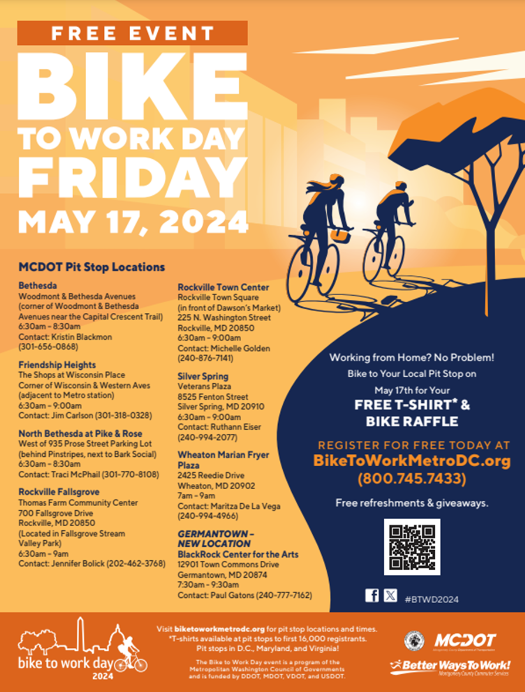
MCDOT will sponsor eight pit stops this year, including a new stop in Germantown at the BlackRock Center for the Arts.
The free pit stop events offer refreshments, music and local vendor displays at varying times throughout the morning of May 17. There will be free raffle prizes and a grand prize raffle of at least one new bike at each of the MCDOT-sponsored pit stops. Residents biking to work, as well as leisure riders, are encouraged to participate.
Registration to participate is now open. The first 15,000 bicyclists to register and participate will get a free t-shirt and will be automatically entered into a raffle for a chance to win a new bike. Registration is encouraged but not mandatory.
 |
CONSTRUCTION UPDATES & PROJECT FEATURES |
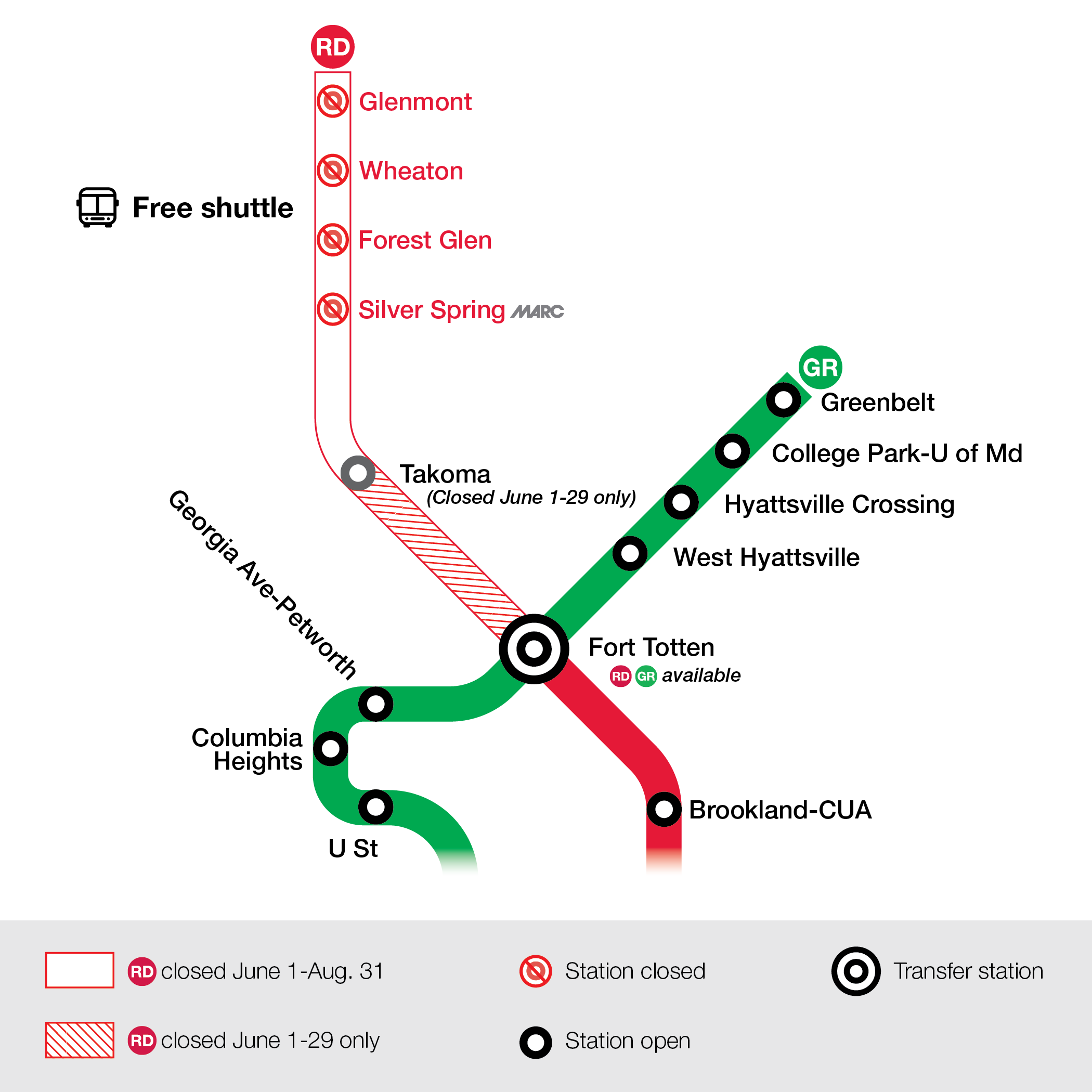
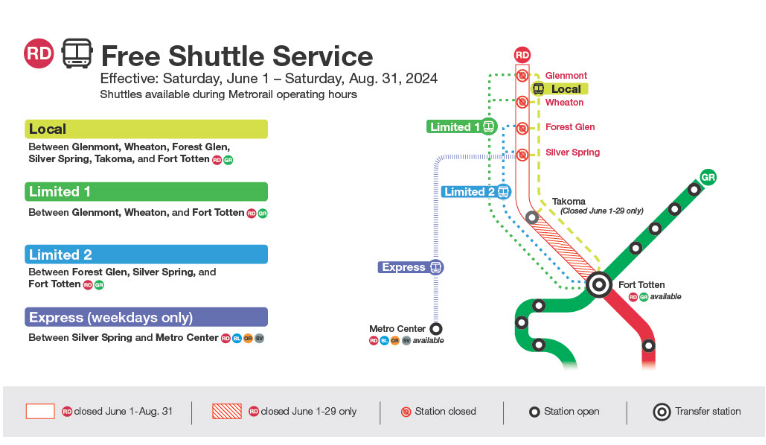
You have probably heard by now that beginning on Saturday, June 1 through Saturday, August 31, the Red Line will be closed between Glenmont and Takoma. Additionally, the closure will extend to Fort Totten through Saturday, June 29, 2024. Make sure to check out this website to see what types of alternative transportation is available for those who must commute between or through those stations. At a press conference yesterday morning, transportation officials announced that they will be providing dedicated bus lanes and changes to signal timing that "will make the shuttle travel seamless." Express, local, and limited services will be available in addition to new bus-only lanes and traffic mitigations.
Important Dates and Service Information: June 1 - Aug. 31, 2024
Free shuttle buses replace Red Line trains between Glenmont and Takoma
Station closures: Glenmont, Wheaton, Forest Glen, and Silver Spring
Red and Green line available at Fort Totten
Note: The closure will extend to Fort Totten from June 1 - 29 only
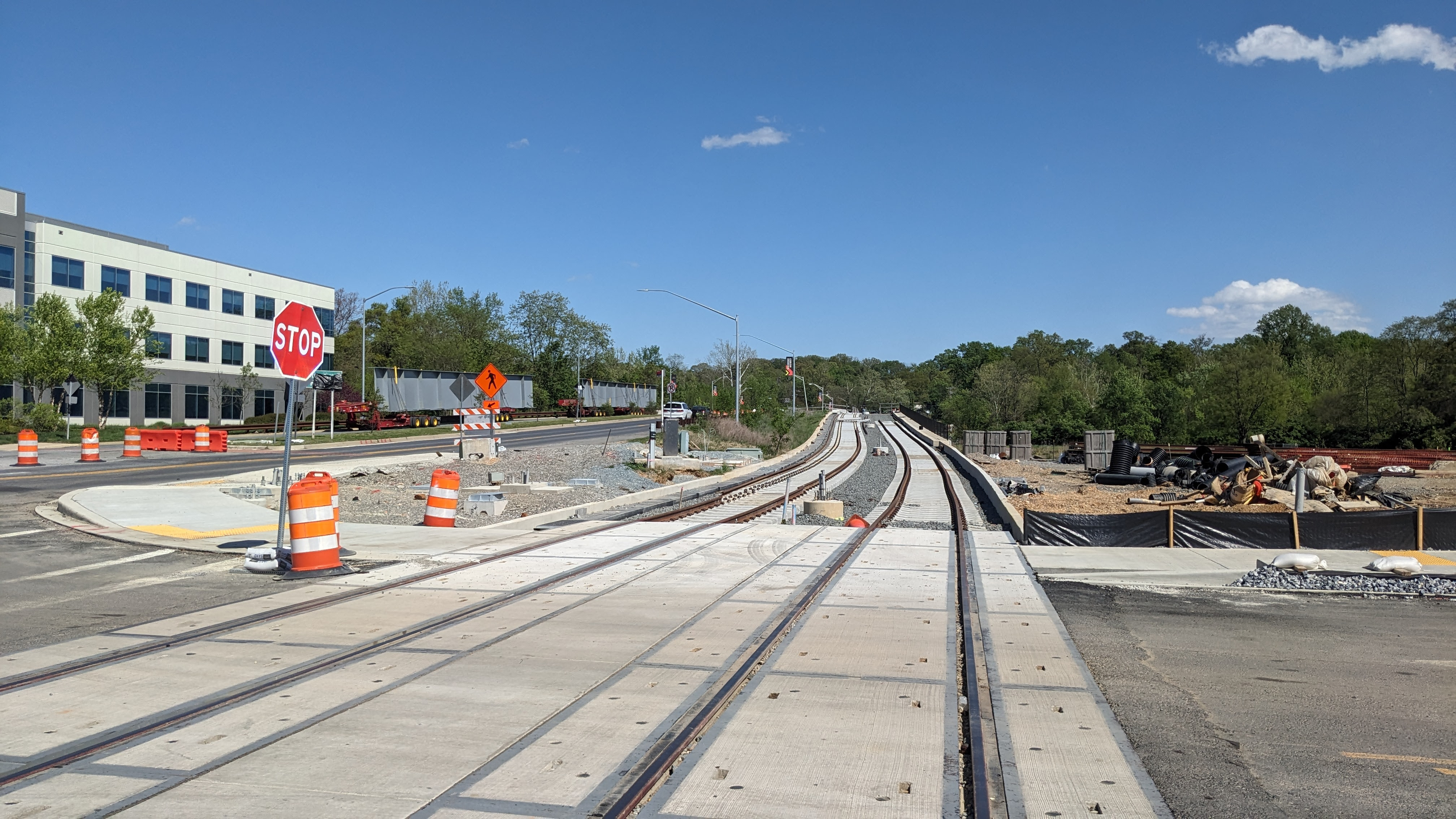
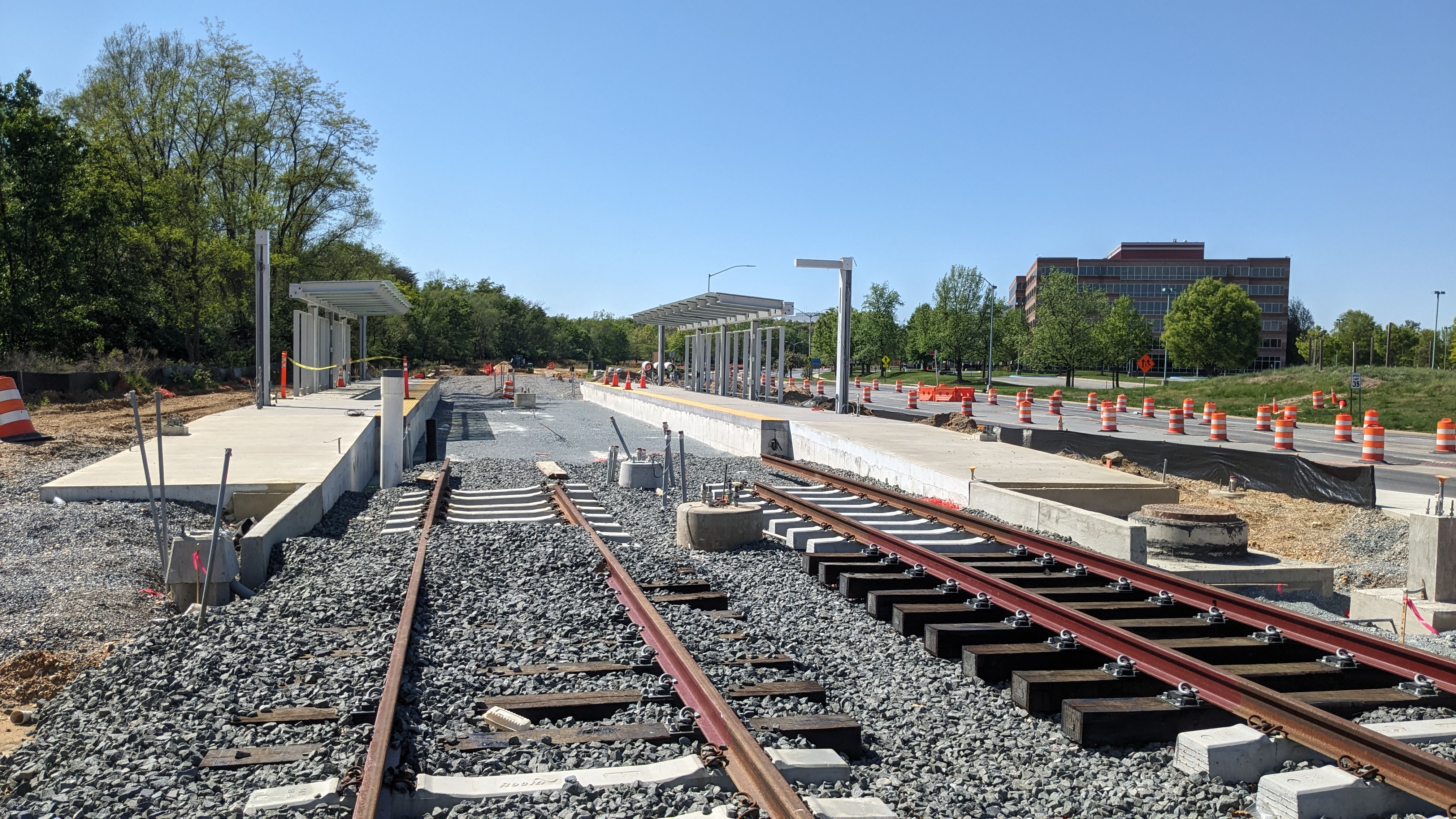
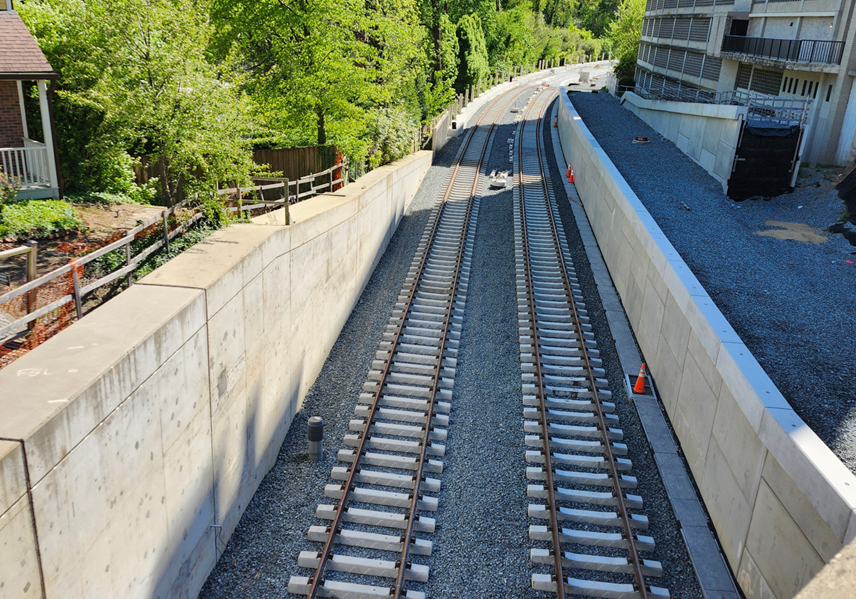
News from the Maryland Purple Line Team -- April Newsletter

|
STAY CONNECTED |
Make sure you are signed up for timely alerts from Purple Line NOW via our Twitter and Facebook pages, and at our website Purple Line NOW.
 |
 |
Please feel free to share this newsletter - no permission from us needed! You can always find a link to our newsletter on our Purple Line NOW website which makes it easy to share with your friends, neighbors, constituents, customers, and employees.
 |
WHAT'S HAPPENING AT PLN? |
Thanks to a grant from the Purple Line Transit Partners, Purple Line NOW will continue our popular Envisioning the Purple Line Forum series this year! We are busy pulling together an educational and informative event and will announce the panel of speakers and date soon. As always, our events are free and open to the public and media, so keep an eagle eye out for the big announcement!
Our need is ongoing - we operate on a budget between $20,000 and $25,000 each year, so please know that your donation in any amount is welcome and necessary for us to continue our work. You can easily donate by clicking the Purple "Donate" button below. Not sure if you've given in the past twelve months? Check our website to see if your name is listed. Thank you from all of us here at Purple Line NOW!
 |
HAPPENING ALONG THE PURPLE LINE CORRIDOR |
The Montgomery County Department of Transportation (MCDOT) will sponsor eight pit stops throughout the County as part of the Washington Region’s participation in “National Bike to Work Day” on Friday, May 17.
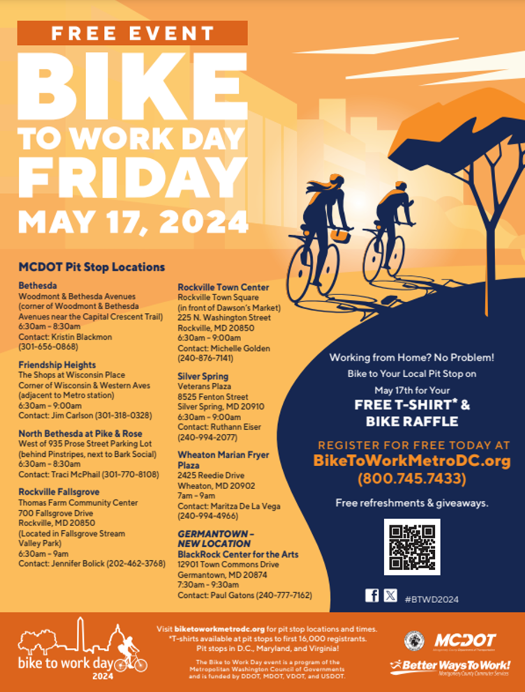
MCDOT will sponsor eight pit stops this year, including a new stop in Germantown at the BlackRock Center for the Arts.
The free pit stop events offer refreshments, music and local vendor displays at varying times throughout the morning of May 17. There will be free raffle prizes and a grand prize raffle of at least one new bike at each of the MCDOT-sponsored pit stops. Residents biking to work, as well as leisure riders, are encouraged to participate.
Registration to participate is now open. The first 15,000 bicyclists to register and participate will get a free t-shirt and will be automatically entered into a raffle for a chance to win a new bike. Registration is encouraged but not mandatory.
Metro customers now have a new way to track performance and plan their travel with the addition of Metrobus data to MetroPulse, Metro’s real-time performance tracking tool.
MetroPulse, launched last summer, gives customers real-time information on bus and train locations, frequency, schedule adherence, and service advisories to help customers make informed decisions about their travel. MetroPulse is a web application currently in beta form, and it complements other performance tracking tools available at wmata.com, including quarterly reports and scorecards detailing on-time performance and customer satisfaction.
The organization is hosting its annual meeting on April 24 in Riverdale Park. If you are interested in attending, you can find more information and register at the link.
|
CONSTRUCTION UPDATES & PROJECT FEATURES |
News from the State: Maryland Purple Line Team Newsletter
News from General Assembly: Shoring Up the Trust Fund

|
STAY CONNECTED |
Make sure you are signed up for timely alerts from Purple Line NOW via our Twitter and Facebook pages, and at our website Purple Line NOW.
 |
 |
***
Our thoughts remain steadfastly with the families of the construction crew missing from the collapse of the Key Bridge early Tuesday morning.
The dedication and sacrifice of these workers to maintain our bridges, roads, and railways for the benefit of our citizens is commendable and deeply appreciated. Their commitment to ensuring the safety and functionality of vital infrastructure exemplifies the spirit of service and resilience that defines our community.
As we mourn the loss of these crew workers, let us also offer our support and solidarity to the families enduring this unimaginable ordeal. May they find strength in the outpouring of compassion from our community.
***
Please feel free to share this newsletter - no permission from us needed! You can always find a link to our newsletter on our Purple Line NOW website which makes it easy to share with your friends, neighbors, constituents, customers, and employees.
 |
WHAT'S HAPPENING AT PLN? |
Thanks to a grant from the Purple Line Transit Partners, Purple Line NOW will continue our popular Envisioning the Purple Line Forum series this year! We are busy pulling together an educational and informative event and will announce the panel of speakers and date soon. As always, our events are free and open to the public and media, so keep an eagle eye out for the big announcement!
Our need is ongoing - we operate on a budget between $20,000 and $25,000 each year, so please know that your donation in any amount is welcome and necessary for us to continue our work. You can easily donate by clicking the Purple "Donate" button below. Not sure if you've given in the past twelve months? Check our website to see if your name is listed. Thank you from all of us here at Purple Line NOW!
 |
HAPPENING ALONG THE PURPLE LINE CORRIDOR |
If you didn't catch the article on women in (Purple Line) construction in the project's newsletter, have a look! The item features the Maryland Transit Solutions Stakeholder Communications Team: Carla Julian, Catherine Webb, Yuval Luger.
Finally, we bring this video done by Dermott Foley, a ninth grader at Montgomery Blair High School in Silver Spring, who won first prize in the Eastern states division of the 2024 StudentCam Competition, a documentary video contest run by C-SPAN. Foley claimed a $3,000 prize for his documentary, titled “The Promise of Langley Park: The Purple Line, Climate Change and Reimagining the Future of America’s Suburbs.” Wow! Congrats to Dermott!
|
CONSTRUCTION UPDATES & PROJECT FEATURES |
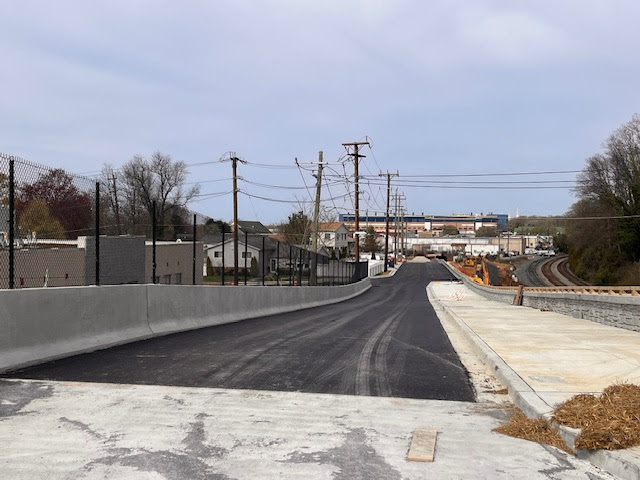
The Maryland Board of Public Works unanimously approved an additional $425 million for the Purple Line construction and a delay of the project start until December 2027. The extension was subject to some controversy, as the project itself was widely supported, though some of the past choices in delivering it were critiqued. Utility relocation has been a major source of work and some of the delay in recent years, although an additional benefit of this work is an upgrade of stormwater management infrastructure across the right of ways. Such upgrades have become more critical due in part to climate change and the importance of good stormwater management by the two hundred year floods occurring in Ellicott City in rapid succession. (Bansil, S. "Maryland officials OK more Purple Line money, but not gladly." Maryland Matters, 13 March 2024.)
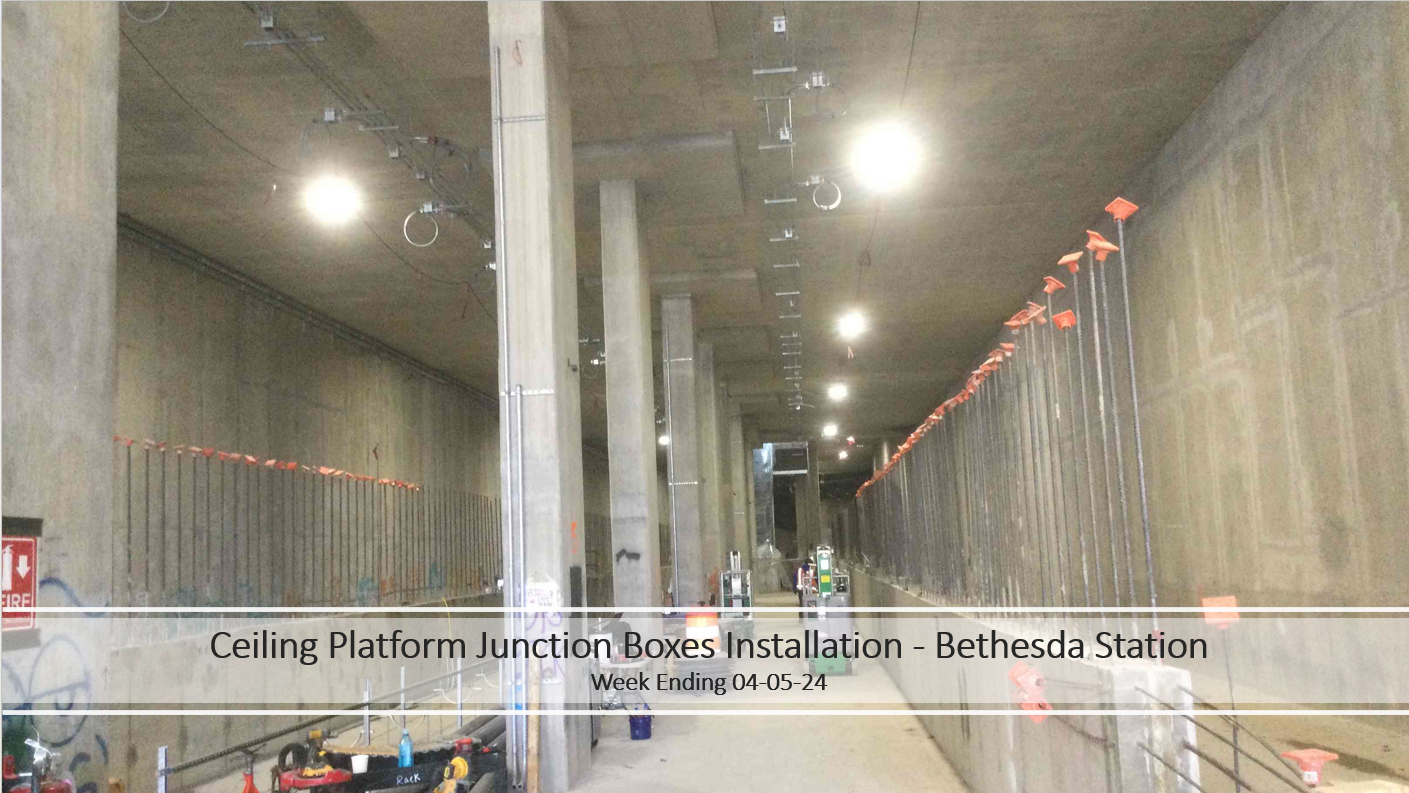
Watch as Montgomery Community Media gets a peak at 135 feet below downtown Bethesda where crews are making way for six elevators, the trains, and a mezzanine where riders will transfer between the Red and Purple Lines.
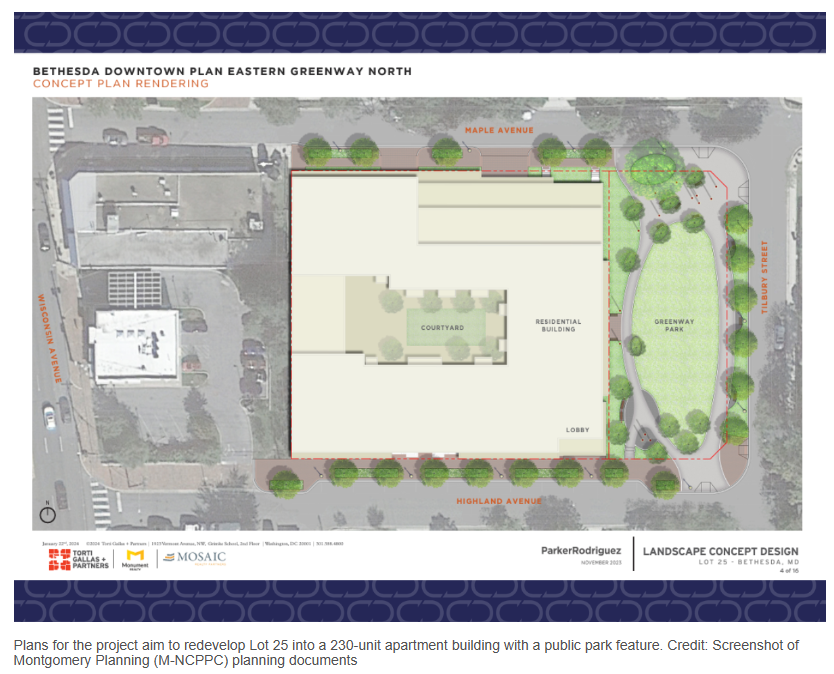
According to Moco360 Media, a developer files plan for 230-unit residential building in downtown Bethesda. The developer, Monument Realty, has proposed an eight-story apartment building with a public park, redeveloping what is now a public parking lot and business strip lining Wisconsin Avenue.
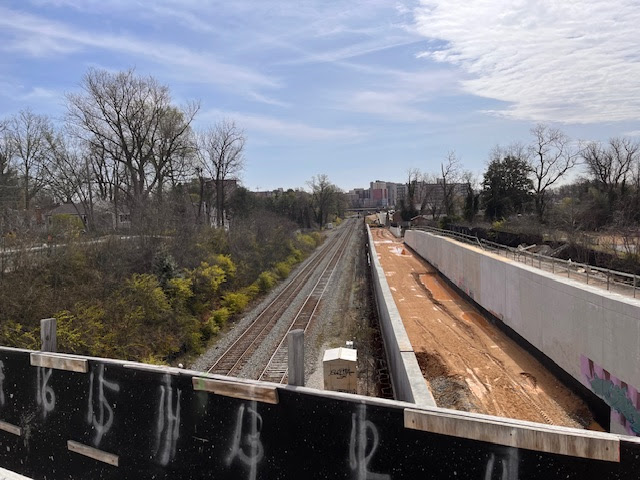
The Rock Creek Park Trail detour will be extended until approximately April 12 at the location of the Purple Line bridge.
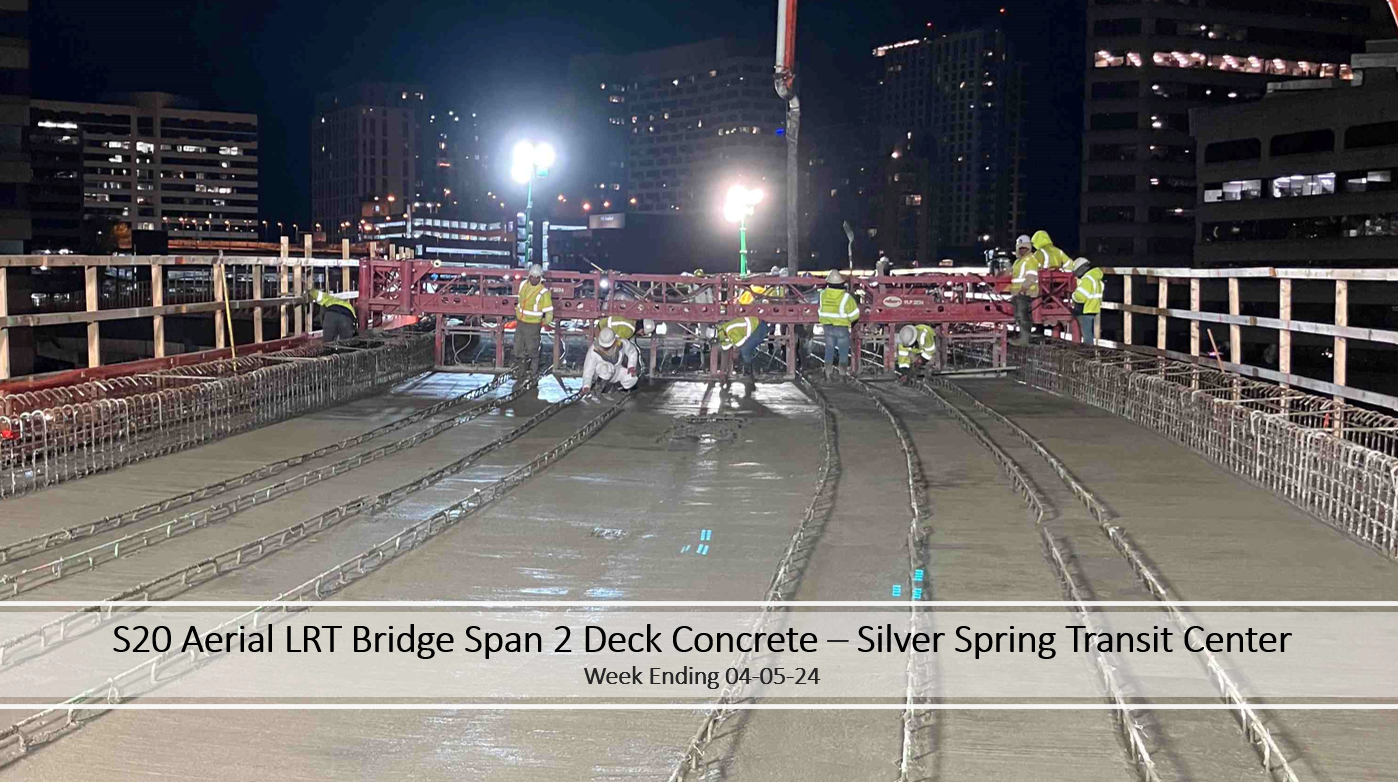
This a a reminder that there is a major Metrorail closure coming our way this summer. This will be a big disruption, but will also bring benefits, not just to the future Purple Line, but also a new connection from the top of the Silver Spring Transit Center directly to the Metro platform. Beginning in early June 2024, the Glenmont, Wheaton, Forest Glen, Silver Spring and Takoma stations on the Red Line will be closed until mid-September 2024.

|
STAY CONNECTED |
Make sure you are signed up for timely alerts from Purple Line NOW via our Twitter and Facebook pages, and at our website Purple Line NOW.
 |
 |
Please feel free to share this newsletter - no permission from us needed! You can always find a link to our newsletter on our Purple Line NOW website which makes it easy to share with your friends, neighbors, constituents, customers, and employees.
 |
WHAT'S HAPPENING AT PLN? |
Purple Line NOW was delighted to learn that our popular Envisioning the Purple Line Forum series has been chosen to receive a grant from the concessionaire, Purple Line Transit Partners (PLTP)!
In a press release issued on January 31, 2024, the concessionaire explained what motivated them to launch this grant program which will help organizations like ours provide valuable services to the greater Purple Line community, “As a long-time member of the community itself, PLTP sponsors the Beyond the Rails community grant program as a way to give back to communities in which PLTP, in partnership with MDOT MTA, is building the Purple Line and through which it will operate the system for 30 years after opening.”
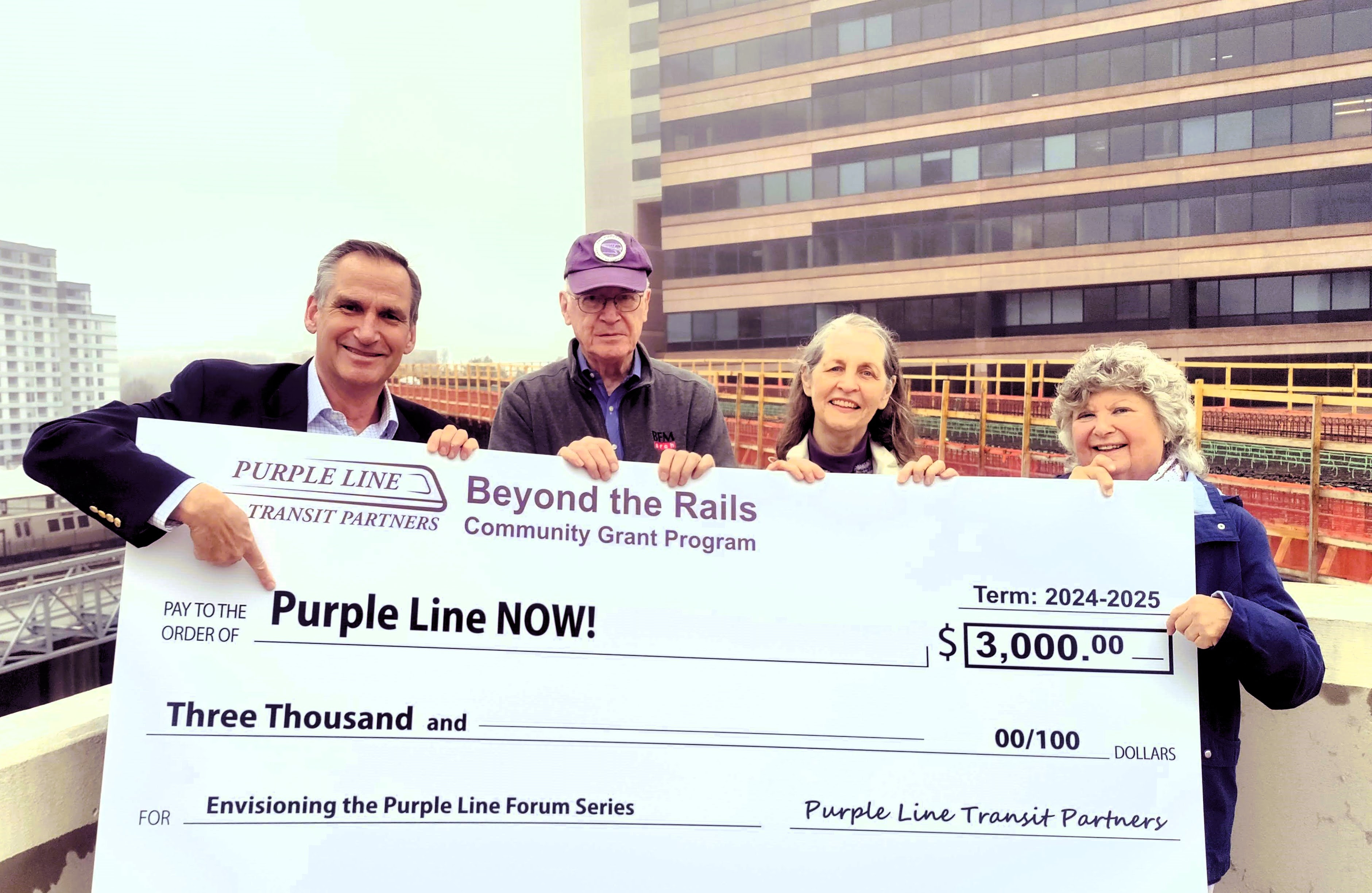
We are honored to be in the company of five other outstanding programs awarded in this inaugural round of grants, all providing valuable services and education to our community! Doran Bosso, PLTP Chief Executive Officer, remarked, “We’re excited to provide financial backing to these six remarkable groups, which work tirelessly to make our local communities better places to live, work and play. Choosing these awardees from the numerous worthy applications we received was not an easy task.”
Purple Line NOW is thrilled to have the opportunity to continue our Envisioning the Purple Line series this year and have already started preparations for the next event, so watch this space!
Our need is ongoing - we operate on a budget between $20,000 and $25,000 each year, so please know that your donation in any amount is welcome and necessary for us to continue our work. You can easily donate by clicking the Purple "Donate" button below. Not sure if you've given in the past twelve months? Check our website to see if your name is listed. Thank you from all of us here at Purple Line NOW!
 |
HAPPENING ALONG THE PURPLE LINE CORRIDOR |
Two items in the Purple Line Corridor Coalition's 2023 End of Year Report caught our eye:
Prince George’s County Pursues Safe Streets for All
The U.S. Department of Transportation awarded Prince George’s County a $21.3 million Safe Streets and Roads for All (SS4A) Grant earlier this year. The SS4A grant funds the Vision Zero Prince George’s “Proud to Pave the Way for Multimodal Safety: Improvements Along the Prince George’s County, MD, High Injury Network” program. This program includes seven safety projects that will help redesign roads to improve visibility, slow vehicle speeds, and promote pedestrian and bicyclist safety in underserved communities. Of those seven, five projects will improve safety along the Purple Line corridor. This is an important step in advancing PLCC’s vibrant communities goal, as it will provide enhanced mobility and accessibility through safer multimodal options and connections for pedestrians, cyclists and all users to travel to and around high traffic Purple Line stations. PLCC looks forward to working with partners to ensure pedestrian and bicycle safety are an integral part of the larger equitable development agenda for the Purple Line corridor.
Montgomery Planning - Strengthening the Pedestrian Experience
The Pedestrian Master Plan, approved this year, is Montgomery Planning’s first comprehensive vision to create safer, more comfortable experiences walking or rolling around the county, and to make getting around more convenient and accessible for every pedestrian. The Pedestrian Master Plan provides detailed, actionable recommendations in line with national and international best practices to improve the pedestrian experience, from more and better places to cross the street to a data driven, equity-focused approach for the county’s future pedestrian/bicycle capital investments. From the beginning of the planning process, the project team has had the Purple Line in mind, working on a Purple Line Connectivity Report to support improved last-mile station connections, and coordinating closely with the PLCC on data collection and analysis. The Pedestrian Master Plan provides an important, long-term foundation for improvements to the safety and efficiency of the pedestrian experience along the Purple Line and beyond.
|
CONSTRUCTION UPDATES & PROJECT FEATURES |
Late last week, officials with the project announced that they will be seeking "approval next month for as much as $425 million in 'relief payments' related to delays in the Purple Line light rail project." According to Maryland Matters, "officials announced the extra payments along with a roughly 234-day delay that will push the line’s completion back from spring of 2027 to December of that year."
Holly Arnold, Administrator of the Maryland Transit Administration, said the money "represents the final payment related to delays in utility work. That work was taken over by the agency in 2020 as the original contractor began to exit from the project, which will connect New Carrollton to Bethesda when it’s completed." Arnold continued, “We made the choice at that time: Let’s keep everything going with this. It’s an important project. We need to keep advancing it. We don’t want to let the community sit with it half finished and suffer for two years. And so doing that we did take on a lot of utility work. Which is a risky part of any project." (Sears, B. "Cost of Purple line increases yet again." Maryland Matters, 1 March 2024.)
Purple Line NOW Vice President Greg Sanders added that this highlights the importance of legislative oversight efforts like the bimonthly project reports and the TRAIN commission which is seeking to address both the revenue and costs sides of Maryland transportation. "Delivering the Purple Line in a timely manner is vital, as is learning and building state government capacity to maintain transit projects and to manage future construction projects like the Baltimore Red Line," he added.

|
STAY CONNECTED |
Make sure you are signed up for timely alerts from Purple Line NOW via our Twitter and Facebook pages, and at our website Purple Line NOW.
 |
 |